Arturo Fermandois
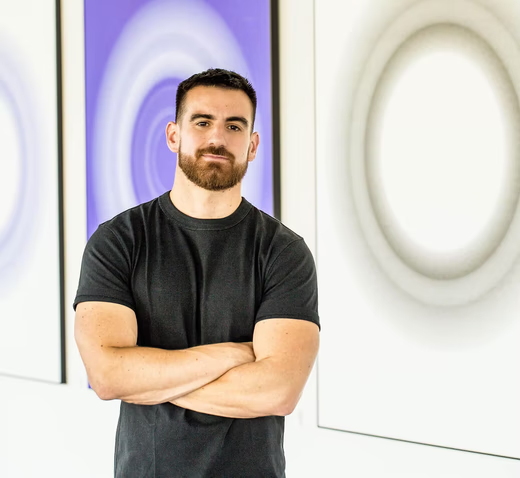
Retrato de Arturo Fermandois en su estudio

Arturo Fermandois (Santiago, 1989) es artista visual y arquitecto por la Pontificia Universidad Católica de Chile. Su trabajo lleva las herramientas de la arquitectura (diseño paramétrico, software de cálculo, lógica constructiva) al terreno de la percepción: una regla geométrica simple, repetida decenas de miles de veces, produce vibraciones ópticas, halos y lo que él llama luz aparente.

Ha realizado exposiciones individuales en Santiago (COSMOS, 2025; ASTROS, 2023; COLOR INESTABLE, 2019) y Miami (HEAVENLY BODIES, 2021), y ha participado en ferias y muestras colectivas en Chile, Estados Unidos, Francia y Perú. En 2024 fue seleccionado en el XVII Premio Arte Joven MAVI UC y obtuvo el primer lugar en el concurso mural de la Fundación Arturo López Pérez. Su obra forma parte de la Colección Ca.Sa. y de colecciones privadas en Chile y Perú. Está representado por Aninat Galería.

Statement

Vengo de la arquitectura. Mi trabajo comenzó cuando entendí que sus herramientas (el diseño paramétrico, el software de cálculo, la lógica constructiva) podían usarse para construir imágenes que no sostienen ni resuelven nada: organizan una experiencia de mirada.

Trabajo con reglas simples repetidas decenas de miles de veces. Lo que me interesa no es la precisión del cálculo, sino lo que aparece cuando ese cálculo se vuelve materia: vibraciones ópticas, halos, condensaciones de luz, una inestabilidad que el ojo no logra resolver del todo. El círculo es el campo central de mi trabajo: una forma capaz de sostener miles de variaciones mínimas sin perder su unidad. Cuando la geometría satura la mirada, la estructura exacta se vuelve fenómeno. El cálculo paramétrico y la impresión contemporánea amplían la precisión, la escala y el número de variaciones posibles respecto del cinetismo histórico; el problema perceptivo, en cambio, es el mismo.

El material es un problema, no un soporte: impresión fine art sobre papel de algodón, impresión UV sobre vidrio de museo, estructuras donde la distancia física entre capas produce profundidad real. La luz no se emite ni se proyecta: aparece como fenómeno perceptivo, derivado de la relación entre superficies, densidades y distancias. Es lo que llamo luz aparente. Donde la arquitectura reúne volúmenes bajo la luz, aquí la luz misma se construye desde la organización de miles de formas geométricas.

Algunas piezas incorporan movimiento mecánico activado por la proximidad del espectador: tiempo real dentro de la imagen. Pero incluso en las obras estáticas el tiempo interviene: cada pieza exige permanencia y devuelve una imagen distinta con cada desplazamiento del cuerpo.


Arturo Fermandois (Santiago, 1989) is a visual artist and architect trained at the Pontificia Universidad Católica de Chile. His practice brings the tools of architecture (parametric design, computational software, constructive logic) to bear on perception: a single geometric rule, repeated tens of thousands of times, produces optical vibration, halos, and what he calls apparent light.

He has held solo exhibitions in Santiago (COSMOS, 2025; ASTROS, 2023; COLOR INESTABLE, 2019) and Miami (HEAVENLY BODIES, 2021), and has taken part in art fairs and group exhibitions in Chile, the United States, France, and Peru. In 2024 he was selected for the XVII MAVI UC Young Art Prize and won first prize in the mural competition of Fundación Arturo López Pérez. His work is held in the Ca.Sa. Collection and in private collections in Chile and Peru. He is represented by Aninat Galería.

Statement

I come from architecture. My work began when I realized that its tools (parametric design, computational software, constructive logic) could be used to build images that carry no load and solve no problem: they organize an experience of looking.

I work with simple rules repeated tens of thousands of times. What interests me is not the precision of the calculation but what emerges when that calculation becomes matter: optical vibration, halos, gathered brightness, an instability the eye never quite resolves. The circle is the central field of my work, a form that can hold thousands of minute variations without losing its unity. When geometry saturates the gaze, exact structure turns into phenomenon. Parametric calculation and contemporary printing extend the precision, the scale and the range of variation beyond what historical kinetic art could reach; the perceptual problem, however, is unchanged.

Material is a problem, not a support: fine art printing on cotton paper, UV printing on museum glass, structures in which the physical distance between layers produces real depth. Light is neither emitted nor projected: it appears as a perceptual event arising from the relation between surfaces, densities and distances. This is what I call apparent light. Where architecture gathers volumes under light, here the light itself is built from the arrangement of thousands of geometric forms.

Some pieces incorporate mechanical movement triggered by the viewer’s proximity: real time inside the image. But time acts in the static works too: each piece asks for duration and returns a different image with every shift of the body.